
Stop Burning Your Best AI Limits on Grunt Work.
Every time Claude Sonnet or Opus writes boilerplate, hits an error, and retries, you are paying premium rates for manual labor. Zenborg puts a Manager → Worker → Reviewer loop over your existing agents—using a smart model to plan and review, and an economical worker to build in an isolated git worktree.
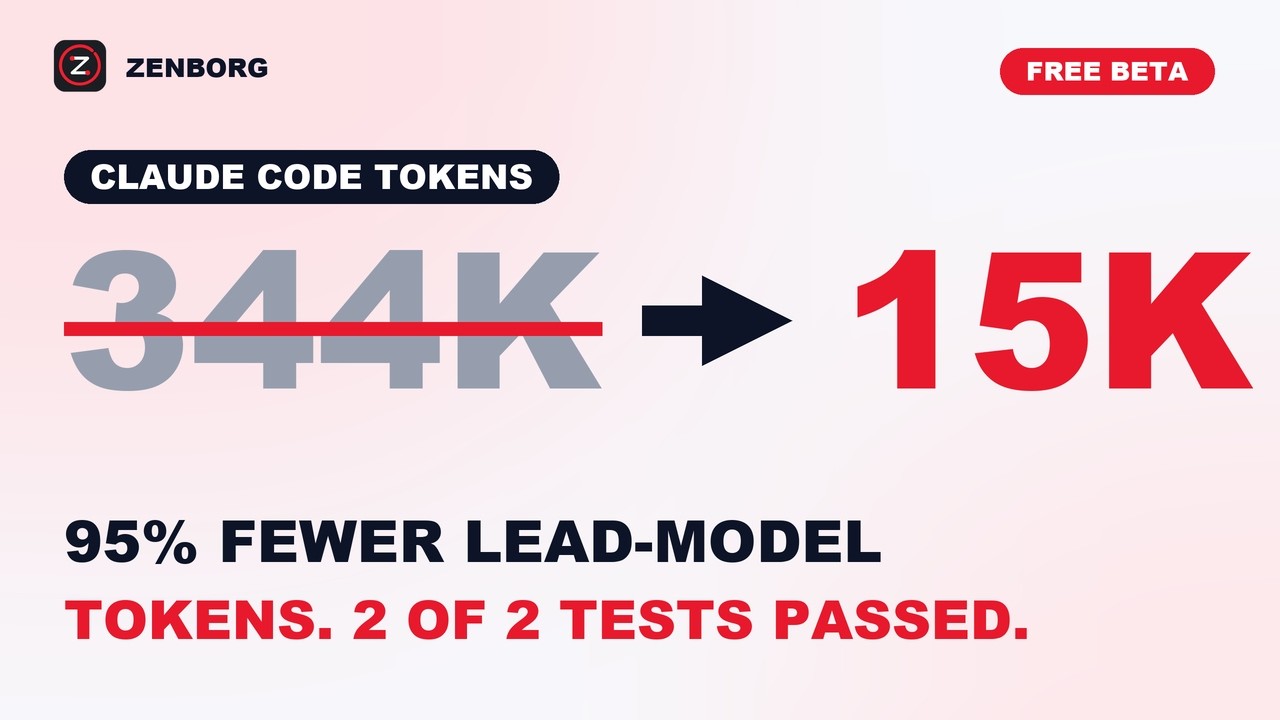
⚡ In our own tests, the same coding tasks cost 56–59% less with Claude and up to 86% less with Gemini when a DeepSeek worker did the coding under your model as Manager.
Free during public beta · No credit card · Runs locally under your own accounts
Verified work. Up to 86% lower cost.
Every time Claude Sonnet or Opus writes boilerplate, hits an error, and retries, you are paying premium rates for manual labor. Zenborg puts a Manager → Worker → Reviewer loop over your existing agents—using a smart model to plan and review, and an economical worker to build in an isolated git worktree.
⚡ In our own tests, the same coding tasks cost 56–59% less with Claude and up to 86% less with Gemini when a DeepSeek worker did the coding under your model as Manager.
Free during public beta · No credit card · Runs locally under your own accounts
Stop Burning Your Best AI Limits on Grunt Work.
Every time Claude Sonnet or Opus writes boilerplate, hits an error, and retries, you are paying premium rates for manual labor. Zenborg puts a Manager → Worker → Reviewer loop over your existing agents—using a smart model to plan and review, and an economical worker to build in an isolated git worktree.
⚡ In our own tests, the same coding tasks cost 56–59% less with Claude and up to 86% less with Gemini when a DeepSeek worker did the coding under your model as Manager.
Free during public beta · No credit card · Runs locally under your own accounts
- ✓Plan written before any code
- ✓Work done in an isolated git worktree
- ✓Manager reviews the diff and sends fixes back
- ✓Project tests must pass before "done"
See how a Manager and a Worker split the job.
A Manager plans and reviews, an economical Worker builds in an isolated git worktree, and you approve what gets kept.
You’re Paying Formula 1 Prices for Stop-and-Go Traffic.
Burning Frontier Limits on Boilerplate
Using Claude Opus or Sonnet to write 500 lines of routine code—and fix its own typos—eats through your 5-hour session cap in minutes. You end up paying for extra AI subscriptions just to keep working.
The Self-Grading Illusion
When one agent plans, codes, and grades its own homework, it misses edge cases (like accepting February 30th as a valid date). You waste hours—and thousands of tokens—debugging "finished" features.
The 30-Second Permission Leash
You sit beside your terminal clicking "Allow" every thirty seconds, copy-pasting red stack traces between windows, and re-explaining your codebase from scratch.
Sound familiar?
You finally have momentum on your project, and then the routine starts again.
- The 30-second leash. You give your AI a task. Thirty seconds later, the screen pauses and chimes: "Can I run this command?" You click Yes. Thirty seconds later, another pause. You click Yes again. Your coffee goes cold while you babysit a machine.
- The fake green checkmark. Ten minutes later it announces: "Done, all tests pass." You open the app to check. The button does nothing. Half the feature is missing.
- The four-window relay. You copy the red error text, alt-tab to another agent window, explain the whole project from scratch, copy its guess back, and pray the two agree.
You started using AI to build things faster. Not to sit beside it clicking "allow" all afternoon.
The fix: put a manager loop over your agents.
In a real team, the person who writes the code is not the only one who checks it. Someone plans, someone builds, someone reviews.
Your AI workflow can work the same way. Right now, one agent plans, builds and grades its own homework, and you babysit the permission prompts. Zenborg fixes that with the Manager Loop. It gives the agents you already use four clear roles:
The Planner plans
The model you already talk to, such as Claude Opus. You tell it what you want in plain English. It maps the plan and defines what "finished" looks like.
The Manager checks
A second model, such as Claude Sonnet. It briefs the Worker, follows each step, and sends mistakes back for repair before you ever see them.
The Worker builds
An economical model, for example DeepSeek flash, or Sonnet, depending on your preferences. In the app, the default Worker is DeepSeek flash (through Hermes, when installed). It writes the files inside an isolated git worktree, so your real files stay untouched until you review and approve.
The Reviewer checks
An independent model, such as Sonnet or an open model like DeepSeek Pro, inspects the Worker's diff against the goal and catches edge cases, so no model grades its own homework.
And Zenborg enforces verified completion: a loop never marks itself "done" until your project's actual tests pass.
You type one sentence. You walk away. You come back to finished, verified work.
Your first loop takes 60 seconds. Literally one sentence.
No dashboards to wire up. No config files to edit. When Zenborg opens for the first time, it automatically connects itself to the AI agents already installed on your Mac or Windows PC.
Open the agent you already use (Claude Code, Codex, Hermes, or OpenCode) and paste this single sentence:
Use Zenborg. Plan this task and start a Zenborg loop with [e.g. Sonnet] as the manager and [e.g. DeepSeek] as the worker. Task: add a contact form to my homepage that emails me the message.
Press Enter.
Your agent becomes the planner, reads Zenborg's built-in guide, briefs the manager and worker, and launches the loop. Watch every step live under Loops in Zenborg's top-left menu.
(Already had your AI open before installing Zenborg? Restart that AI window once so it picks up the new tools.)
Verified work. Up to 86% lower cost.
In our own tests, the same coding tasks cost 56–59% less with Claude and up to 86% less with Gemini when Zenborg ran the work: your model as Manager, a DeepSeek worker doing the coding.
Results of our own tests
| Setup | Manager | Worker | Cost vs. the same model alone | Tests passed |
|---|---|---|---|---|
| Claude alone | Claude | Claude | 100% | 4/4 |
| Zenborg | Claude | DeepSeek | 41–44% (−56% to −59%) | 4/4 |
| Gemini alone | Gemini | Gemini | 100% | 4/4 |
| Zenborg | Gemini | DeepSeek | 14% (−86%) | 4/4 |
4 real coding tasks from the Zenborg codebase, judged by the same hidden tests for every run. Cost is the API usage cost of each run. Single test run; results will vary. Tasks take longer to finish with Zenborg because the work runs in the background.
How we measured
Models: Claude Sonnet 5.5; Gemini 4 Hydrogen; DeepSeek flash / V4.1 Flash as the worker.
- Claude, our own test (DeepSeek worker via Hermes): $1.25 → $0.52
- Claude, independent test (DeepSeek worker): $1.38 → $0.61
- Gemini, independent test (DeepSeek worker): $5.19 → $0.74
API cost of the test run, not Zenborg pricing.
An agent that grades its own homework misses things.
Example: the February 30th bug
In one of our own test tasks, a calendar module, the worker agent finished building, ran its own self-written tests, saw all green checkmarks, and reported success.
Its logic quietly accepted February 30th as a valid calendar date, alongside two other hidden bugs.
Inside a Zenborg loop, the reviewer caught all three bugs, rejected the draft, and sent exact repair instructions back to the worker. After the repair, the hidden acceptance tests passed.
One example from our own testing, not a guarantee. Results depend on your project, your agents and your tests.
Biggest help: multi-file features and real fixes. Adding a signup flow, wiring up emails, or chasing a bug across five files is where a second pair of eyes catches the most.
Small help: one-line tweaks. Changing a button colour or fixing a typo does not need a three-role team, so there is little to gain there.
Your agent pair matters. Which agents you pick as Manager and Worker changes the result, and a checked loop can take longer on the clock than a solo sprint because it refuses to skip the review.
"I stopped babysitting my agents."
"I built Zenborg because I was paying for four separate AI subscriptions just to survive my daily limits—and still spending half my afternoon clicking 'Allow' and copy-pasting errors. Once I put a Manager → Worker → Reviewer loop over my agents, the cost of the same coding tasks dropped by more than half in our own tests. I cancelled two of my four subscriptions immediately, and my remaining limits now cover everything I build."
Let your agents brainstorm with you in one thread.
Stop copying the same prompt between separate agent windows. Bring the agents you already use into one conversation inside Zenborg.
Brainstorm together
Ask for several agents to weigh in on architecture, naming or trade-offs, and read one clean thread.
Direct hand-offs
One agent can @mention another specialist the moment it spots a question outside its lane.
You read one thread. You make the final call.
Need an expert on call? Create one safely in one sentence.
Most people paste random "agent skills" off the internet without checking what is hidden inside. That is how prompt injections and malware sneak into local setups. In Zenborg, you ask your AI for the specialist you want, and it builds a clean, security-checked expert for you:
Use Zenborg. Create a [e.g. SEO copywriter] agent for me:
1. Research online what a great [role] does and which skills matter most.
2. Find the best existing skills for this role and scan every one of them for malware, prompt injections and security holes.
3. Write your own clean version of those skills and install them on the new agent.
4. Give the agent its role: a successful [role] with over 40 years of experience. Write the perfect role description for it.
A few minutes later, your new specialist shows up in every chat and every loop. No config forms. No unvetted third-party files running on your machine.
Stop Wasting Tokens Today. Start Free in 60 Seconds.
- ✓Everything unlocked: unlimited local projects, parallel loops, and custom security-scanned agents.
- ✓Keep your existing accounts: works with Claude Code, Codex CLI, Hermes, OpenCode, and any MCP-compatible agent.
- ✓Lower your AI bill: pair your model as Manager with an economical worker like DeepSeek. In our own tests, the same coding tasks cost 56–86% less (see the benchmark above).
- ✓100% local & private: runs on your Mac or Windows machine inside isolated git worktrees. Zero code leaves your setup except to your own AI providers.
- ✓Zero billing traps: no credit card required to join the beta.
Questions before you start
Do I need to be a programmer?
Which AIs do I need?
Is my code private and safe?
What happens when the beta ends? Will I get charged?
What if the worker writes broken code?
Windows Store user: what if my AI cannot see Zenborg?
How does Zenborg lower the cost of the same coding tasks?
Keep your limits. Keep your afternoon. Let the manager handle it.
100% Free Public Beta · No credit card · Mac & Windows · Key in your inbox in under 60 seconds